

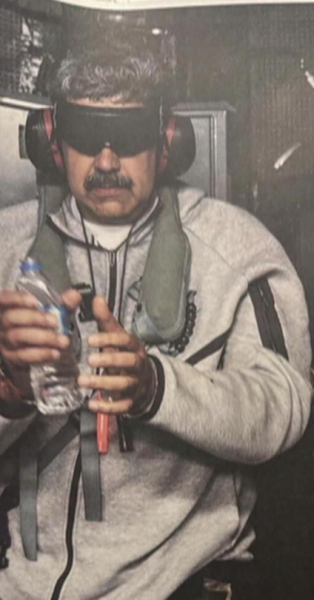
 In the early hours of January 3rd, 2026, Caracas witnessed an event that will be recorded in the pages of Venezuelan history for generations to come. Among numerous explosions, a U.S. helicopter was headed to the Palacio de Miraflores, the Venezuelan Presidential Residence. Its mission was clear: to arrest the “President” of Venezuela, Nicolás Maduro, and his wife, Cilia Flores. On that day, the US summarised what would change Venezuelan history in only 3 words: “Operation Absolute Resolve.”
The “Operation Absolute Resolve” encountered little to no resistance in Caracas. This was a result of the previous American intervention in Venezuelan electric and information systems, enabling them to cut the electricity supply in strategic parts of the city, leaving the city defenceless.
Thereby, in the span of 4 hours, the US forces penetrated the city and exited the country, taking as a trophy Maduro and his wife. While the number of casualties remains uncertain, the estimates say that in total, around 75 people died. From which the majority were Venezuelan forces and security, with some Cuban casualties, and only 2 Civilians killed. Surprisingly, there were no American casualties, making President Trump describe this operation as “brilliant”.
Shortly after, President Trump gave the speech in Mar-a-Lago, claiming this was a crucial victory for his campaign against trafficking, terrorism, and immigration.
These are President Trump’s comments about this matter: “We’re going to run the country until we can do a safe, proper, and judicious transition.”-
This quote explained everything that Trump had planned for the country. On one hand, it will be in his interest to take Chavism out of Venezuelan politics, potentially being a positive change for the country. On the other hand, it confirms what many feared after hearing about the intrusion: Venezuela will be subjugated under American dominance until further notice.
Making this situation even more controversial are Trump’s campaign promises. Specifically, his advocacy for American indifference amid a tense political scene directly contradicts his decisions regarding Venezuela. As a result of this, Trump will most surely lose credibility in the average American’s eyes. However, it will not be the first time that Trump does so, and, compared to the 2016 elections, he actually won around 14million votes in the 2025 elections, making the future of American politics sensitive and unpredictable.
In NYC, Maduro was taken to the federal court. What shocked the world was that the former Venezuelan leader was limping through the hall and, despite this, greeted the guards in his own way: “Good evening, happy new year.” This was pointed out to be a message of the world stating, “I’m not finished, I’m innocent”. A couple of days later, he pleaded not guilty and is awaiting trial in American Soil.
During Maduro’s absence, Vice-President Delcy Rodríguez took control of the country as stated in the constitution. She immediately called for the liberation of the Chavist leader; however, she backed down under Trump’s threats of a second intrusion in the country.
Additionally, the legitimacy of her government was widely questioned around the world, with some claiming that she wasn’t even the Vice-President, as there has been no conclusive proof proving Maduro’s re-election in 2025. For this reason, it is prohibited for her to travel to the EU or the Schengen area.
Venezuela itself has seen a social split between those who support Trump’s “liberation” and those who support Rodríguez and Maduro as their rightful leaders. Adding fuel to the fire is the decision of letting American companies extract the Venezuelan oil in exchange for money and stabilise the country’s economy, and a truce to not attack the country again.
The aftermath of this event severely impacted the world, much beyond South America. China stated this as “Illegal and Bullying”, showing their full support to the Venezuelan Chavist regime. Meanwhile, Russia went along with China, stating this as “attacking Venezuelan sovereignty” and “extremely aggressive”. Even the EU showed its discontent with the situation, describing this as “a threat to international stability”.
However, numerous leaders also supported the operation. For example, the UK’s prime minister “shed no tears” for Maduro’s regime. Some responses in Latin America were El Salvador’s Nayib Bukele’s support, or Argentina’s Milei, who even cheered the operation with his usual slogan “Viva La Libertad C*rajo”, translated to“Long Last F*cking Freedom.”
On the other side of the coin are President Trump’s personal incentives to attack the country. Some claim that Trump’s getting some personal advantage out of the situation. For instance, they claim that Trump is keeping a portion of the profit from Venezuelan oil for himself. Backing these speculations is the questionable path of the money. According to CNN, about half a billion dollars of profits are being held in a Qatari bank. The Trump administration addressed this topic, saying that these are just funds for Venezuela, although a lot of critics have spoken out, stating that this is corruption. However, the truth is that there is a lack of evidence that can both prove or deny these speculations.
Analysts claim that his real interest does not lie with the oil, but with the country itself. Venezuela is one of the most important allies to the Axis of Upheaval(Russia, China, North Korea, and Iran). For Trump, limiting Communist/socialist spheres of influence in Latin America is crucial, as seen with his actions against Cuba and support towards countries willing to separate themselves from Chinese trade.
Trump’s objective will not only be to reduce the Axis of Upheaval’s sphere of influence, but also to physically isolate them. The Axis of Upheaval relies on Venezuela as its major ally in the Americas and a way of projection to the Western Hemisphere. Even though Cuba is a valuable ally, its bad economy and numerous US military bases have made this Island more of an economic burden than an actual ally. By knocking out Chavism, Trump not only aims to knock out a valuable ally from the Axis of Upheaval, but also wants to limit Socialist expansion in all of Latin America.
President Trump’s official reasons, however, are different. The Republican leader explained the real reason for capturing the former Venezuelan leader was his involvement in “El Cártel de los soles,” the Cartel of the Sun in English. This is a criminal Narco-trafficking organisation linking Colombian guerrilla groups with the Venezuelan and Cuban Governments. His reason to attack Venezuela and take as a hostage Maduro hostage was to make the Western Hemisphere “a much safer place to be,” stating that it was “an attack for justice”.
These policies have been effective for the US until now, as they have successfully reduced drug trafficking and separated the Axis of Upheaval from Latin America. However, future concerns rise as the uncertainty of his next action grows. Will it be Greenland? Will it be Canada? Will it be Panama? The truth is, Trump’s strategy has always been to say something and do what matches the reaction to the outrage over his comments. Following Europe’s indifference after Maduro’s capture, Trump consolidated his move. However, following Europe’s indignation at American intentions to acquire Greenland, “The easy way, or the hard way”, Trump backed down; he realised that this would be “NATO’s death certificate”, as the Spanish president highlighted in an interview.
The future is uncertain, but every abrupt action puts world stability at risk. The most likely outcome is that Trump backs down and stops more land claims that directly affect his allies, as he has seen that the gain is minimal, and the risk is too high. However, what’s certain is that Trump will do whatever is in his power to limit the axis’s influence in the Americas, and more importantly, when it directly affects the U.S.
In the future, it won’t be crazy to predict that Trump will pressure yet another country to solidify American supremacy, but the most likely outcome is that he stops pressuring other NATO members over what most leaders would rate as “Childish”.